
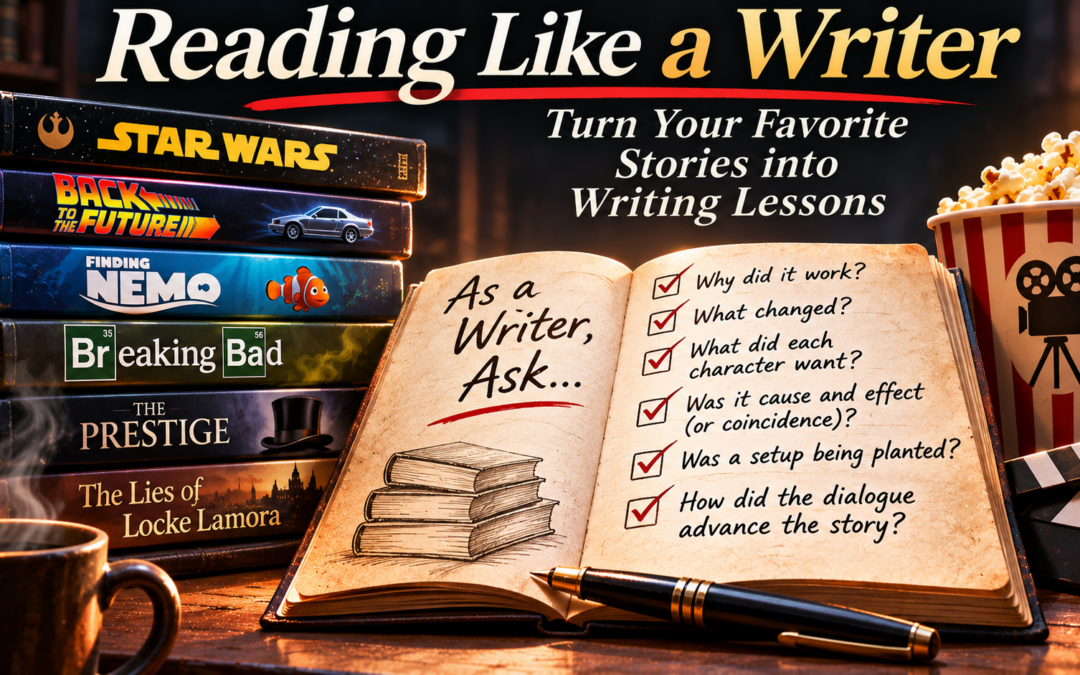
Main Street Writes Discussion Topic – Originally presented 7/27/2026
Imagine finishing an incredible novel or watching an unforgettable movie.
Most people come away thinking:
“That was great!”
But writers should ask a different question:
“Why was it great?”
What made the characters compelling? Why did a particular scene work? How did the author build tension, create an emotional response, or deliver a satisfying surprise?
Every book we read and every movie we watch offers an opportunity to study how accomplished storytellers solve the very problems we face in our own writing.
The goal isn’t to imitate another author’s style.
It’s to understand why their choices worked.
Looking Beyond the Rules
Beginning writers often become preoccupied with writing rules.
Show, don’t tell.
Avoid adverbs.
Don’t use too much exposition.
Never begin with backstory.
Then we read enough successful books and discover something surprising.
Professional writers break these rules all the time.
So what gives?
The problem isn’t necessarily the advice. It’s treating useful guidelines as absolute laws.
Sometimes a fully dramatized scene is the most effective choice.
Sometimes a single sentence of summary accomplishes more than five pages of dialogue.
Sometimes exposition is exactly what the reader needs.
Experienced writers aren’t simply asking whether a particular technique is allowed.
They’re asking:
“What’s the best tool for the job?”
And that’s a particularly valuable question to consider when reading someone else’s work.
The Lies of Locke Lamora: When Telling Works
During one of our group discussions, a member raised an interesting observation about Scott Lynch’s The Lies of Locke Lamora.
The novel’s opening relies heavily on exposition, background information, and narrative summary.
We’re introduced to Locke’s childhood, the Thiefmaker, Father Chains, and the criminal underworld of Camorr.
Rather than dramatizing every event in Locke’s upbringing, Lynch moves through substantial amounts of background information, establishing the world and the circumstances that shaped his protagonist.
At first glance, a developing writer might object:
“But we’re supposed to show, not tell!”
Reading like a writer encourages us to ask something more useful.
Why did Lynch choose to summarize these events?
What information does the reader gain?
Which moments deserve complete scenes, and which can be conveyed more efficiently through narration?
Imagine trying to dramatize every important event from Locke’s childhood before reaching the central story.
The novel could become considerably longer—and potentially much slower.
The interesting question isn’t whether Lynch violated a writing rule.
It’s whether his choices accomplished what the story needed.
Star Wars: Exposition in Plain Sight
Here’s another familiar example.
The original Star Wars begins with an opening crawl.
Before we meet Luke Skywalker, we learn that the galaxy is engulfed in civil war, that Rebel spies have stolen secret plans, and that Princess Leia is being pursued by the Empire.
It’s pure exposition.
George Lucas could have devoted an entire sequence to showing us those earlier events.
Instead, he summarizes the essential background and immediately moves into the action.
The audience has enough context to understand what’s happening without watching every event that led up to it.
Different medium. Different genre.
Same storytelling principle: summarize what the audience needs to know, then dramatize what deserves their attention.
Learning to Recognize the Techniques
Once we begin looking for deliberate storytelling choices, familiar stories become valuable teaching tools.
Consider Back to the Future.
On a first viewing, we’re entertained by Marty’s adventures.
On a second viewing, we can appreciate how carefully earlier details prepare us for later events. The clock tower, George McFly’s confidence, and even seemingly casual conversations become important.
Or consider Breaking Bad.
Instead of simply watching Walter White create increasingly dangerous situations, we can study how his pride and decisions generate the consequences that drive the plot.
The more closely we examine these stories, the more we recognize techniques we’ve discussed in our writers’ group:
Character flaws. Wants versus needs. Scene turns. Escalation. Causality. Setups and payoffs.
The techniques rarely operate independently. They work together to create the experience we enjoy.
A Practical Exercise: Watch or Read with Purpose
Choose a book, movie, or television episode you already love.
Experience it again, but this time pay attention to the craftsmanship.
When you encounter a particularly effective moment, ask yourself:
- Why did this scene work?
- What did the characters want, and what changed?
- How did the author control the pacing or reveal information?
- Was there an earlier setup that made this moment more satisfying?
- Could I use a similar technique in my own writing?
You don’t need to analyze every sentence or scene.
Just identify a few choices that made the story effective.
Then consider how those techniques might help solve problems in your own work.
Closing Thought
One of the greatest resources available to writers is the enormous collection of stories we already love.
Every successful novel, film, or television series contains lessons about characterization, structure, dialogue, pacing, and countless other aspects of storytelling.
And sometimes the most valuable lessons come from discovering that an accomplished writer has broken a rule we thought was essential.
The goal isn’t to abandon the rules.
It’s to understand the craft well enough to know when—and why—to use different techniques.
Don’t just admire a great story. Study what makes it great.
Because sometimes the best writing teacher you’ll ever have is the book you’re already reading.
Related Discussions
- Every Scene Needs a Turn — Understanding what makes individual scenes effective.
- Flaws That Drive Plot — Recognizing how character weaknesses shape a story.
- The Lie the Character Believes — Examining the false beliefs beneath compelling character arcs.
 Scott Boyer grew up in Santa Monica, CA and still resides in the Los Angeles area. Graduating from the Haas School of Business at UC Berkeley in 1996, he started writing Bobby Ether And The Academy with the goal of blending YA fantasy with spiritual fiction. Nowadays, Scott splits his time between helping his father manage an insurance brokerage, playing with his Shepherd-mix rescue dog Patch, and writing other adventures in the Bobby Ether series.