
Main Street Writes Discussion Topic – Originally presented 6/15/2026
Most stories begin with a problem.
The protagonist wants something, but obstacles stand in the way.
The challenge isn’t necessarily creating those obstacles. It’s making sure the story becomes progressively more compelling as the protagonist confronts them.
That’s where the escalation ladder comes in.
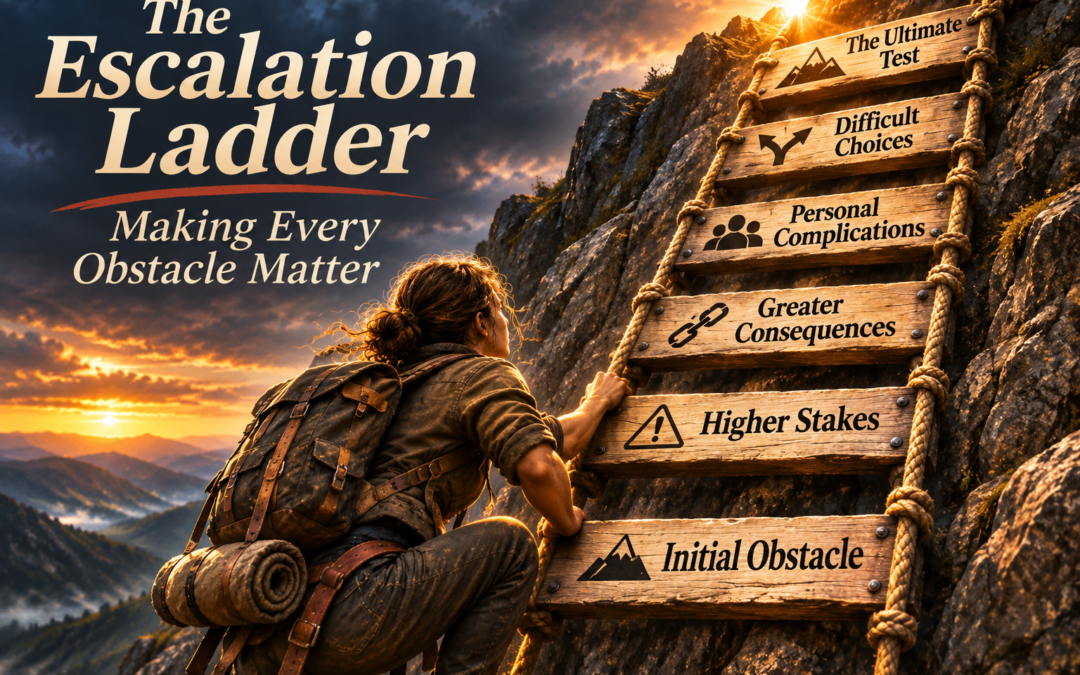
Think of a ladder. Each rung takes us higher than the last.
In storytelling, each significant obstacle should increase the pressure on our protagonist.
But here’s the important distinction:
Escalation doesn’t necessarily mean bigger explosions, stronger enemies, or greater physical danger.
It means making the situation more difficult, more costly, or more consequential.
Escalation vs. Repetition
Imagine a ranger carrying an urgent message to the king.
First, a storm forces him off the road.
Then a bridge washes out.
Then he runs low on supplies.
Finally, his horse goes lame.
These are legitimate obstacles, but notice what’s happening.
The ranger keeps encountering variations of the same problem: getting to the capital.
The journey becomes more difficult, but the underlying conflict doesn’t really change.
Now imagine something different.
The storm forces the ranger to seek shelter at a remote farmhouse.
There, he discovers that the farmer is his long-lost father.
Then he learns that the message he’s carrying orders the destruction of several villages—including his father’s home.
His father begs him to destroy the message.
But disobeying the king would be treason, punishable by death.
Suddenly, the ranger faces a terrible choice.
Does he remain loyal to his king or protect his family?
The story hasn’t simply become harder. It’s become more meaningful.
What began as a physical challenge has become a personal and moral dilemma.
That’s effective escalation.
Familiar Examples
Titanic — Escalating on Two Levels
In Titanic, Jack and Rose initially face social and emotional obstacles.
Their relationship challenges the expectations of Rose’s family and her engagement to Cal.
Then the ship strikes the iceberg.
Suddenly, their personal conflict unfolds against a catastrophe.
Jack is imprisoned. The ship begins sinking. Passengers discover there aren’t enough lifeboats.
Rose must make increasingly difficult choices between her own safety and the person she loves.
Notice how the story escalates on two levels simultaneously.
The physical danger increases, but so does the emotional cost of every decision.
The sinking ship makes the relationship conflict more consequential.
Top Gun: Maverick — Increasing Pressure and Sacrifice
In Top Gun: Maverick, Maverick is assigned to prepare an elite group of pilots for an extraordinarily dangerous mission.
But Rooster, the son of Maverick’s deceased friend Goose, is among those pilots.
Their strained relationship introduces deeply personal stakes.
As training progresses, the mission appears increasingly difficult. The deadline tightens, pilots struggle, and Maverick’s authority is challenged.
Eventually, Maverick is shot down behind enemy lines.
Rooster must decide whether to risk his own life to save him.
The conflict has escalated from a professional assignment into a test of loyalty, sacrifice, and unresolved grief.
The final challenge isn’t simply harder to accomplish. It’s more personal than the first.
Different Ways to Escalate Conflict
Writers have several ways to increase tension without simply introducing another villain or obstacle.
- Stakes: More people, relationships, or important goals are threatened.
- Consequences: Failure becomes increasingly costly.
- Relationships: Trust breaks down, allies leave, or loyalties are tested.
- Information: New discoveries reveal that the situation is worse than expected.
- Time pressure: A deadline approaches, reducing the protagonist’s options.
- Internal conflict: A character’s flaws or false beliefs create increasingly serious problems.
- Difficult choices: Success requires sacrificing something important.
These approaches often overlap.
Consider a protagonist who lies to avoid confrontation.
The first lie prevents an uncomfortable conversation.
The second damages a friendship.
The third destroys someone’s trust.
Eventually, the protagonist must choose between confessing everything and losing someone they love—or continuing the deception and risking something even worse.
The same flaw drives each problem.
But the consequences keep escalating.
The character’s own decisions create the increasingly difficult circumstances.
How Escalation Connects to Other Writing Techniques
We’ve previously discussed how every scene needs a turn—something that changes the situation.
Escalation ensures those changes matter.
We’ve also explored character flaws and the lie a character believes.
A strong story can place increasing pressure on those flaws and beliefs until the protagonist can no longer avoid their consequences.
And in our discussion of midpoint shifts, we examined how a major revelation or decision can change the story’s direction.
Escalation builds pressure before and after those turning points.
These techniques work together to create momentum.
A Quick Exercise
Think about your current work-in-progress.
Identify four or five major obstacles your protagonist faces.
Now ask yourself:
- Is each new obstacle meaningfully different from the last?
- Are the consequences becoming more significant?
- Does the protagonist have to change their approach?
- Are the challenges becoming more personal or emotionally costly?
Not every scene needs to be more intense than the previous one. Stories need moments of relief, reflection, and slower pacing.
But the underlying conflict should continue developing.
If your protagonist keeps solving essentially the same problem over and over, your story may be moving forward without actually building momentum.
Closing Thought
Escalation isn’t about making everything bigger.
It’s about making things matter more.
The strongest stories don’t simply throw increasingly powerful enemies at their protagonists.
They introduce complications that force characters to adapt, reconsider their beliefs, and make progressively more difficult choices.
And sometimes the greatest escalation isn’t physical at all.
It’s emotional.
The first obstacle should challenge the protagonist. The last obstacle should threaten everything they care about.
Because eventually, the most compelling question isn’t simply:
How do I win?
It’s:
What am I willing to lose?
Related Discussions
- Every Scene Needs a Turn — Why meaningful changes keep scenes moving.
- Flaws That Drive Plot — How character weaknesses create problems and consequences.
- The Lie the Character Believes — How false beliefs drive decisions and conflict.
 Scott Boyer grew up in Santa Monica, CA and still resides in the Los Angeles area. Graduating from the Haas School of Business at UC Berkeley in 1996, he started writing Bobby Ether And The Academy with the goal of blending YA fantasy with spiritual fiction. Nowadays, Scott splits his time between helping his father manage an insurance brokerage, playing with his Shepherd-mix rescue dog Patch, and writing other adventures in the Bobby Ether series.