
Main Street Writes Discussion Topic – Originally presented 6/8/2026
Every good story needs a beginning and an ending.
But what about the middle?
One of the biggest challenges in fiction is maintaining momentum after the opening excitement has passed but before the climax begins.
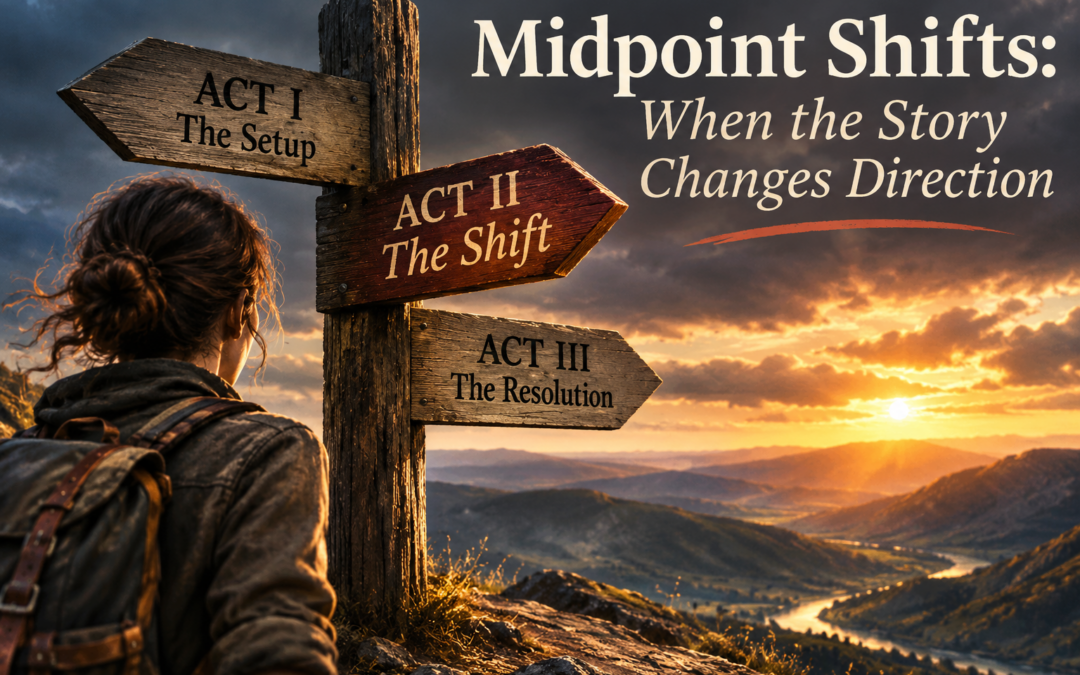
Many successful stories solve this problem with a midpoint shift—a significant event, discovery, or decision that changes the direction of the story.
A midpoint isn’t just where the story is halfway over. It’s where the story changes direction.
What Makes a Midpoint Shift?
A midpoint shift is more than another obstacle.
It’s a turning point that changes what the protagonist knows, wants, or must do.
Consider a detective investigating a murder.
Discovering another clue moves the investigation forward.
But discovering that the person helping her solve the case is actually the killer?
That changes everything.
Suddenly, her assumptions, priorities, and strategy must change.
The story before that revelation and the story after it are fundamentally different.
From Reacting to Acting
In many stories, the protagonist spends the first half reacting to circumstances.
They’re learning, surviving, gathering information, and making mistakes.
Things happen to them.
But near the midpoint, something changes.
They uncover the truth, make a commitment, or recognize what must be done.
Now they begin taking deliberate action.
The midpoint often marks the transition from reacting to the story to actively shaping it.
This isn’t a universal requirement, but it’s a useful storytelling pattern.
Familiar Examples
Jurassic Park — From Wonder to Survival
Early in Jurassic Park, the characters are exploring an extraordinary scientific achievement: living dinosaurs.
There’s wonder, excitement, and growing concern about whether such a place can be controlled.
Then the security systems fail and the Tyrannosaurus escapes.
Suddenly, the story changes from exploring the possibilities of bringing dinosaurs back to life to surviving the consequences.
The central question shifts from “What have they created?” to “How do we survive it?”
Titanic — From Romance to Survival
For much of Titanic’s first half, we’re watching Jack and Rose develop a relationship that challenges their social circumstances.
Then the ship strikes the iceberg.
Their relationship remains central, but now everything unfolds against an approaching catastrophe.
The romantic conflict becomes entangled with the struggle to survive.
A strong midpoint doesn’t erase the first half of the story. It changes the significance of what came before.
Connecting the Midpoint to Character Development
We’ve previously discussed wants versus needs, character flaws, and the lie a character believes.
A midpoint often challenges those elements.
Suppose a protagonist believes they can never trust anyone.
For much of the story, they refuse help and insist on handling everything alone.
Then their refusal to trust someone causes a devastating failure.
Suddenly, their worldview is challenged.
Do they recognize their mistake and begin changing?
Or do they double down on their false belief?
Either response can create a compelling second half.
The midpoint doesn’t necessarily transform the character immediately. It forces them to confront something they can no longer ignore.
Different Types of Midpoint Shifts
Midpoint shifts generally involve one or more of four developments:
- Revelation: The protagonist discovers something that changes their understanding of the conflict.
- Commitment: They make a decision that eliminates the possibility of turning back.
- Victory: They achieve an important goal, only to discover that success creates a larger problem.
- Defeat: They suffer a setback that makes their original strategy impossible.
The key isn’t which type we choose.
It’s whether the event meaningfully changes what happens next.
A Quick Exercise
Think about your current work-in-progress.
Ask yourself:
- What important discovery, event, or decision occurs near the middle?
- How does it change the protagonist’s understanding, goals, or strategy?
- Does the second half of the story unfold differently because of it?
That last question is particularly important.
If you could remove your midpoint event and the second half would remain essentially unchanged, perhaps your story needs a stronger turn.
Closing Thought
We’ve previously discussed how every scene needs a turn—something that changes the situation.
A midpoint shift applies that principle to the larger story.
The protagonist may learn something important, make a difficult choice, or discover that their original objective no longer matters.
Whatever form it takes, the change should influence everything that follows.
Sometimes the best way to fix a sagging middle isn’t to add more obstacles. It’s to change what the story is really about.
Related Discussions
- Every Scene Needs a Turn — How meaningful changes keep individual scenes moving.
- The Lie the Character Believes — How false beliefs shape decisions and character development.
- Flaws That Drive Plot — How character weaknesses create conflict and consequences.
 Scott Boyer grew up in Santa Monica, CA and still resides in the Los Angeles area. Graduating from the Haas School of Business at UC Berkeley in 1996, he started writing Bobby Ether And The Academy with the goal of blending YA fantasy with spiritual fiction. Nowadays, Scott splits his time between helping his father manage an insurance brokerage, playing with his Shepherd-mix rescue dog Patch, and writing other adventures in the Bobby Ether series.